Mary had asked for only one thing before our son’s wedding.
“Don’t let them make my illness the center of the day.”
She said it from the edge of our bed while holding the brown wig in both hands like it was something alive.
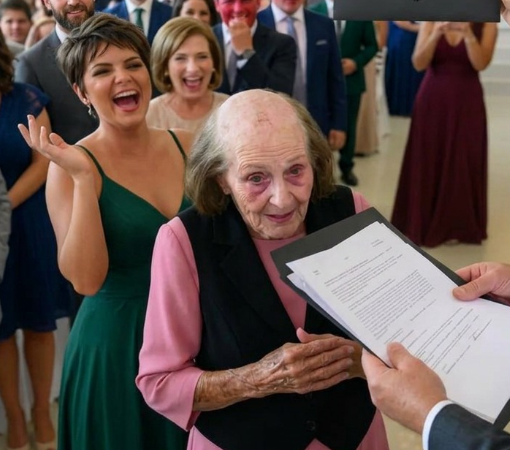
The morning light was soft against her face, but it could not soften what treatment had done.
Her cheeks were thinner.
Her hands trembled more often.
The skin along her scalp had become tender from months of treatment, and the gray hair that remained came in faint, uneven wisps that she tried not to touch when she looked in the mirror.
Mary was not vain.
That is what people misunderstood.
She had worn plain shoes most of her life, bought dresses only when old ones could no longer be mended, and kept the same pearl earrings for thirty-six years because Lucas once said they made her look “like a movie mom.”
She did not want beauty.
She wanted dignity.
That should not have been too much to ask at her own son’s wedding.
Lucas was our only child.
For years, Mary had built her life around him with a devotion that looked ordinary only because good mothers make sacrifice seem quiet.
She packed his lunches.
She sat through rain-soaked soccer games.
She worked extra shifts when tuition came due.
She slept in hospital chairs when he had pneumonia at nine.
She saved every handmade card he ever gave her in a blue box inside our closet.
When he met Jennifer, Mary tried harder than anyone to welcome her.
Jennifer came from money.
Not comfortable money.
Commanding money.
Her father, Richard, owned Vanguard Logistics, a company everyone in their circle spoke about with careful respect.
Her mother had the polished politeness of a woman who could insult a waitress without changing tone.
Jennifer had inherited both the money and the polish, but none of the grace.
At first, Mary did not see it.
Or maybe she saw it and forgave it too quickly.
Jennifer criticized the flowers in our garden, then called it honesty.
She made jokes about Mary’s cooking, then called it teasing.
She corrected Lucas in public and touched his arm afterward, as if ownership could be disguised as affection.
I disliked her within ten minutes.
Mary told me to be fair.
“She makes Lucas happy,” she said.
I remember looking at my wife across the kitchen table and thinking that kindness sometimes survives by lying to itself.
Then came the diagnosis.
Stage-three cancer.
The words arrived in a doctor’s office that smelled like antiseptic and coffee gone cold.
Mary sat beside me with her hands folded in her lap while the oncologist explained treatment, scans, side effects, insurance forms, medical directives, and timelines.
She nodded through all of it.
She asked practical questions.
She thanked the doctor.
Then we got to the parking garage, and she leaned against the passenger door and cried so hard she could not breathe.
That was the Tuesday morning everything changed.
That was also the morning I began preparing.
Not for revenge.
For protection.
After I drove Mary home, I went to an attorney.
I reviewed power of attorney forms, bank statements, property deeds, beneficiary clauses, and medical directives.
I amended what needed to be amended.
I removed what needed to be removed.
I put certain assets into a trust that could not be reached by panic, guilt, or a son too easily guided by the wrong woman.
Signed.
Dated.
Notarized.
Stamped.
I did not tell Mary every detail.
She had enough needles in her life already.
But I told her the truth that mattered.
“You will be protected.”
She smiled at me from the couch, tired and beautiful.
“I always have been.”
The wedding was scheduled six months after the diagnosis.
Mary considered not going.
Not because she did not love Lucas, but because her body was exhausted, and the idea of being watched frightened her more than she wanted to admit.
Lucas begged her to come.
Jennifer did too, though Jennifer’s voice carried a sweetness I did not trust.
“We want you there, Mary,” she said over speakerphone. “You’re family.”
Mary looked at me when she heard that.
She wanted to believe it.
So we went.
The ballroom was expensive in the way rooms become expensive when every surface is designed to announce it.
Tall cream walls.
Crystal chandeliers.
Pale flowers so perfect they looked almost artificial.
White tablecloths.
Silver trays.
A stage washed in bright lights.
Guests moved through the room in formal clothes, carrying champagne and smiling with the delicate caution of people who knew exactly which family had paid for everything.
Mary wore a pale blue dress.
Lucas had once told her that color looked beautiful on her, and she remembered.
Of course she remembered.
Mothers remember the smallest compliments from children who forget giving them.
She adjusted her wig in the car before we went inside.
“Does it look natural?” she asked.
I took her hand.
“You look like my wife.”
That made her laugh.
It was a small laugh, but I held onto it.
During the ceremony, Lucas cried when Jennifer walked down the aisle.
Mary cried too.
I watched her watching him.
Her face carried pain, pride, fear, memory, and something that looked dangerously close to goodbye.
Cancer had made her practical.
She had started saying things like “in case” and “afterward” in a voice too calm for the words.
But that day she wanted to be only his mother.
Not a patient.
Not a diagnosis.
Not a woman people whispered about behind floral arrangements.
For a while, I thought the day might pass gently.
Then the reception began.
Jennifer loved attention the way fire loves oxygen.
She held the microphone too long.
She laughed too loudly.
She touched Lucas’s lapel, corrected his posture, and thanked her father three separate times for “making the dream possible.”
Richard accepted the praise from the front row as if the ballroom were a board meeting and the wedding were another acquisition.
Mary sat beside me near the family table.
She was tired.
I saw it in the way she pressed two fingers against her temple.
I asked if she wanted to leave after dinner.
She shook her head.
“After the toast,” she said. “I want to hear Lucas speak.”
That sentence still hurts me.
Because Lucas never got the chance to become the memory she wanted.
Jennifer did.
She called Mary onto the stage.
At first, the request sounded innocent.
“We want to honor the woman who raised my husband,” Jennifer said.
A few guests clapped.
Mary looked startled, then touched her wig quickly.
I leaned toward her.
“You don’t have to.”
She smiled at me.
“It’s for Lucas.”
That was Mary.
Even then.
Especially then.
She walked onto the stage slowly.
The lights were too bright on her face.
Jennifer put one arm around her shoulders and spoke into the microphone about family, strength, and “showing up even when life gets hard.”
The words were lovely.
That made them worse.
Cruelty dressed as tribute is still cruelty.
Then Jennifer reached toward Mary’s head as if she were only fixing a loose strand of hair.
“Here, Mary, let me fix that for you…”
I saw Mary flinch.
I started to stand.
But Jennifer’s fingers had already closed around the edge of the wig.
It happened quickly.
Sharp.
Cruel.
The adhesive loosened.
The wig came away in Jennifer’s hand.
She did not drop it in horror.
She lifted it.
Like a trophy.
The ballroom froze.
Forks stopped halfway to mouths.
A bridesmaid’s glass shook in her hand.
A waiter stood near the head table with a tilted tray.
The music faded oddly, as if even the speakers did not know whether they were allowed to continue.
Under the stage lights, Mary’s bare head was exposed.
Thin gray hair.
Tender skin.
The visible signs of months of cancer treatment.
For a few seconds, nobody seemed to understand what had happened.
Then a few people laughed.
Not many.
Enough.
A few guests laughed, and that was all it took to turn the room into a wound.
“Oh my God,” Jennifer said into the microphone, performing shock so badly that only a coward could pretend to believe it. “I had no idea it would come off so easily!”
I looked at Lucas.
He stood only a few feet away.
Close enough to step in.
Close enough to take the wig from Jennifer.
Close enough to put his arms around the woman who had carried him into this world.
He did nothing.
His face flushed, not with anger for his mother, but with embarrassment because of her.
Then he turned slightly away.
That was the moment something broke between us.
Mary did not scream.
She did not cry.
She did not beg.
She pulled her hands close to her chest and tried to shrink inside the pale blue dress she had chosen for him.
Not the laughter.
Not the cruelty.
Her silence.
Sometimes the deepest humiliation does not make a sound.
It simply stands inside someone who has already suffered far too much.
I rose from my chair.
The legs scraped the ballroom floor, and the sound cut through the laughter like a blade.
For one ugly second, I looked at the champagne flute in my hand and imagined it shattering across Jennifer’s perfect table.
I set it down.
Mary needed a husband more than she needed a man losing control.
I walked to the stage.
The guests moved aside.
Their faces blurred at the edges.
I remember perfume.
I remember warm food going cold.
I remember Jennifer still holding the wig.
I climbed the steps and removed my navy jacket.
Then I placed it over Mary’s shaking shoulders and covered her head as gently as I could.
She looked up at me.
Her eyes were full of tears.
But they were still searching the room for Lucas.
That nearly destroyed me.
I took the microphone from Jennifer’s hand.
She resisted for half a second.
Then she saw my face and let go.
“I apologize for interrupting the evening,” I said. “But since all of you have just watched a sick woman be turned into entertainment, it only seems fair that you also witness the wedding gift I brought for my son.”
The room went completely still.
Jennifer’s smile remained, but now it looked trapped.
I turned toward Lucas.
“Lucas,” I said. “I brought you a gift tonight.”
He finally looked at me.
I reached into my shirt pocket and removed the thick black envelope sealed with wax.
It was not a card.
It was not cash.
It was not a cheerful wedding gift meant to be opened between cake and champagne.
It was the result of six months of preparation.
I broke the seal.
The documents slid into my hand.
Signed.
Dated.
Notarized.
Stamped.
Guests in the front row leaned forward.
Jennifer’s mother went still.
Richard narrowed his eyes.
Lucas took one small step, as if his body had understood danger before his mind did.
Jennifer gave a nervous laugh.
“So dramatic.”
I did not look at her.
I turned the first page so Lucas could read the heading.
Revocation of Beneficiary Designation.
His mouth opened.
No sound came out.
I placed the next page beside it.
Amended Property Trust.
Then another.
Medical Decision Authority.
Then another.
Removal from Joint Real Estate Transfer Option.
Every page had been prepared through the attorney’s office.
Every signature was mine.
Every date was clean.
Every stamp was official.
The documents did not shout.
They did not need to.
Jennifer’s smile disappeared as though the light had been switched off behind her eyes.
“What is this?” Lucas whispered.
“This,” I said, “is what happens when a man forgets who stood beside his mother when she was too sick to stand alone.”
Mary made a small sound behind me.
I almost turned.
But if I turned then, I would have stopped.
And I was not done.
Jennifer stepped toward Lucas.
“Don’t listen to him,” she said. “He’s emotional.”
That word found the wrong place in me.
Emotional.
As if paperwork prepared over six months was emotion.
As if notarized documents were grief.
As if the only rational people in the room were the ones laughing at a woman with cancer.
I looked at Jennifer.
“No,” I said. “I was emotional when I watched you touch my wife’s head. This is administrative.”
A murmur moved through the ballroom.
Lucas looked at the papers again.
“You removed me?”
“I protected your mother.”
“That money was supposed to help us start our life.”
“No,” I said. “That money was supposed to help your mother survive hers.”
Richard rose from the front row.
He was a large man, not just in body but in presence.
Some people enter rooms.
Richard occupied them.
His dark suit was perfectly tailored.
His expression had the measured anger of a man who had settled problems with phone calls for most of his adult life.
“You’ve made your point,” he said.
I looked down at him from the stage.
No.
I had not.
I had been waiting for him.
Hoping for him, actually.
I reached into my second inside pocket and removed another envelope.
This one was thinner.
Sharper.
Crueler.
“Come on, Richard,” I said calmly. “Step forward and collect your piece.”
Richard stopped at the bottom of the steps.
The confidence disappeared from his eyes.
Predators recognize another predator when the other man has nothing left to lose.
“You run Vanguard Logistics, don’t you?” I asked.
He swallowed.
“You already know that.”
“And you know who now owns the debt held by your largest creditor?”
The room became heavy.
Toxic.
Suffocating.
Jennifer’s mother covered her mouth with one hand.
I let the truth sink in slowly.
“My holding company purchased your toxic loans this morning, Richard.”
Someone in the back whispered.
Richard’s face changed color.
“You have been in default for three months.”
I dropped the envelope at his feet.
“Your warehouse seizure begins Tuesday morning.”
Richard staggered and grabbed the stage railing.
The powerful man in the front row was gone.
What remained was an old man watching his empire burn.
Jennifer looked from him to me.
For the first time all night, she seemed truly frightened.
Not ashamed.
Frightened.
There is a difference.
Shame asks what it has done.
Fear asks what it will lose.
Lucas bent and picked up one of the documents with trembling fingers.
“Dad,” he whispered. “Please don’t do this here.”
Mary lifted my jacket slightly from around her shoulders.
Her voice was weak, but it carried through the microphone still in my hand.
“Did you know she planned this?”
The question landed harder than any document.
Lucas froze.
Jennifer turned toward him too quickly.
That was her mistake.
Every guest saw it.
Every phone camera caught it.
My son looked at his mother.
Then at his bride.
Then at the wig lying on the stage floor.
For one second, I thought he might finally become the man Mary had raised.
Instead, he said, “Mom, it was just a mistake.”
The room changed after that.
Even Richard looked away.
Mary closed her eyes.
I had seen her endure needles, nausea, scans, pain, and fear.
Nothing had made her look as wounded as that sentence.
I picked up the final page from the black envelope.
Then I held it where Lucas could see the signature line.
“This is the last thing I needed to decide tonight,” I said.
He looked at the page.
It was an addendum.
A final beneficiary clause.
There had still been one account I had not removed from him.
Not because I forgot.
Because Mary asked me to wait.
“She said you might remember who you were,” I told him.
Lucas stared at his mother.
Mary did not open her eyes.
“She was wrong,” I said.
Then I signed.
Right there on the stage.
In front of his bride.
In front of her family.
In front of every guest who had laughed, frozen, or looked away.
The attorney had told me the witness line could be completed later under formal review if necessary.
But the intent was clear.
The act was clear.
The room understood.
Lucas understood too.
His knees seemed to weaken.
Jennifer reached for his arm, but he pulled away without looking at her.
It was the first decent thing he had done all evening.
Too late.
But decent.
Richard bent slowly and picked up the envelope at his feet.
His hands shook.
I watched him read the first page.
Loan acquisition notice.
Default confirmation.
Secured asset enforcement schedule.
Tuesday morning.
He looked up at me.
“You wouldn’t.”
I smiled then.
Not because I enjoyed it.
Because some men only understand mercy after it has been removed.
“I already did.”
Jennifer’s mother began crying quietly.
Jennifer stood in her wedding dress with my wife’s wig still in her hand.
When she realized she was still holding it, she dropped it as if it had burned her.
Mary saw it fall.
So did I.
I walked over, picked it up, and placed it gently in Mary’s lap.
Then I helped my wife stand.
The ballroom parted for us as we came down from the stage.
Nobody laughed now.
Nobody moved.
The same people who had found her humiliation amusing could not meet her eyes when she walked past them with my jacket over her shoulders.
That is the thing about public cruelty.
It relies on the crowd staying a crowd.
The moment each person remembers they have a face, they start looking for somewhere to hide it.
At the exit, Lucas called after us.
“Dad.”
I stopped.
Mary’s hand tightened around my arm.
I did not turn around right away.
When I did, my son was standing at the edge of the stage, surrounded by documents, flowers, and the wreckage of what should have been his wedding night.
“What am I supposed to do?” he asked.
I looked at him for a long time.
Then I said the only honest thing left.
“Start by picking up your mother’s wig.”
He looked down.
He did not move.
So I walked out.
Mary and I left before the cake was cut.
In the car, she sat silently with my jacket around her shoulders and the wig folded in her lap.
I expected her to cry.
She did not.
After several minutes, she said, “He didn’t choose me.”
I gripped the steering wheel.
“No.”
The word was too small.
But it was true.
She nodded once, as if confirming a diagnosis she had already suspected.
Then she looked out the window.
“I still love him.”
“I know.”
“That makes it worse.”
“I know.”
The next morning, the video was everywhere in their circle.
Not because I posted it.
Because cruelty had invited witnesses.
Jennifer’s friends had recorded her little performance from three angles.
One clip showed the wig coming off.
Another showed Lucas turning away.
Another showed me opening the envelope.
By noon, Richard’s company partners were calling.
By Monday, Vanguard Logistics’ board had requested an emergency meeting.
By Tuesday morning, the warehouse seizure began exactly as stated.
Richard tried to fight it.
Of course he did.
He hired lawyers.
He made calls.
He claimed coercion, timing, malice, and emotional distress.
But debt does not care about embarrassment.
Default is default.
The creditor position had been acquired legally.
The notices had been issued properly.
The documents had been filed.
Signed.
Dated.
Stamped.
Again.
Jennifer and Lucas did not leave for their honeymoon.
They spent the week arguing in a hotel suite paid for by a credit card that Richard’s office later froze.
Three days after the wedding, Lucas came to our house.
Mary was asleep.
He stood on the porch holding the blue box from our closet.
The one filled with his childhood drawings.
I do not know how he got it.
Maybe he had taken it months earlier when helping Mary sort storage.
Maybe she had given it to him.
He held it like an offering.
“I want to see Mom,” he said.
“No.”
His face crumpled.
“Dad.”
“She is resting.”
“I need to explain.”
“No,” I said. “You need to understand. Explanation is what people ask for when they want forgiveness before accountability.”
He stared at the floorboards.
“I was embarrassed.”
“I know.”
“I panicked.”
“I know.”
“I didn’t think Jennifer would actually—”
I stepped closer.
“You watched your sick mother be humiliated in front of a ballroom, and the first person you protected was yourself.”
He started crying then.
I wish I could say it moved me.
It did not.
Not that day.
Mary chose not to see him for three weeks.
That was the first boundary I had ever seen her keep without apologizing.
Treatment continued.
Some days were brutal.
Some mornings, she could barely sit up.
But something in her changed after that wedding.
Not hardened.
Clarified.
She stopped asking whether people would think she was rude.
She stopped covering her head in the house.
She stopped making excuses for Lucas.
When he finally visited, he came alone.
No Jennifer.
No Richard.
No performance.
He sat at the kitchen table where he had once done homework while Mary cooked dinner behind him.
For a long time, no one spoke.
Then Mary said, “Did you know she was going to pull it off?”
Lucas cried before answering.
“No.”
Mary nodded.
“Did you know she might hurt me?”
He closed his eyes.
“Yes.”
That was the answer that mattered.
Mary looked at him with a sadness I cannot describe.
“Then you knew enough.”
He apologized.
Not beautifully.
Not perfectly.
But honestly.
Mary listened.
She did not forgive him that day.
Forgiveness is not a wedding favor.
It is not owed because someone finally feels bad.
It comes when the injured person has enough safety to decide what to do with the wound.
Jennifer never apologized to Mary.
She sent a message through Lucas two months later, calling the whole thing “a misunderstanding during a stressful day.”
Mary deleted it.
Richard lost control of two warehouses before restructuring.
His pride suffered more than his fortune, which for men like him is often the greater injury.
Jennifer and Lucas separated before their first anniversary.
People said the marriage ended because of money.
They were wrong.
The marriage ended because the wedding revealed exactly what it had been built on.
Performance.
Cowardice.
Cruelty.
And silence.
Mary’s treatment continued for another year.
There were good scans and bad ones.
There were hospital nights when I slept in chairs and mornings when she made jokes with nurses just to prove cancer had not taken her manners.
Lucas came often after the separation.
At first, Mary let him sit only in the living room.
Then the kitchen.
Then, eventually, beside her during one treatment session.
He never asked for the inheritance back.
That helped.
Not enough to erase what happened.
Enough to prove he had learned the difference between apology and transaction.
One afternoon, Mary asked me to bring down the blue box.
She opened it slowly.
Inside were drawings, cards, school photos, old ribbons, and a folded note Lucas had written when he was seven.
It said, “Mom, I will always protect you.”
Mary read it twice.
Then she handed it to Lucas.
He broke.
Not loudly.
Not dramatically.
He folded over the paper and cried into his hands like a child.
Mary watched him.
Then she placed one thin hand on his shoulder.
That was not forgiveness.
Not completely.
But it was a door.
And unlike the doors Jennifer and Richard had built, this one was not locked from the outside.
People later asked whether I regretted opening those envelopes at the wedding.
They asked if I went too far.
They asked if the moment could have been handled privately.
I always say the same thing.
Mary’s humiliation was public.
So was my answer.
If Jennifer had chosen cruelty in private, I might have answered in private.
But she chose a microphone.
She chose stage lights.
She chose an audience.
I simply refused to let the last word belong to her.
Mary still has the pale blue dress.
She does not wear it.
But she kept it.
Not as a memory of pain, she told me once, but as proof that she survived a room full of people who forgot she was human.
The brown wig is gone.
One morning she threw it away herself.
Then she stood in front of the mirror with her thin gray hair, touched her scalp gently, and said, “I think I’m tired of hiding for other people.”
I stood behind her.
“You look like my wife.”
This time, she smiled without sadness.
At our next anniversary dinner, she wore the pearl earrings Lucas had loved as a boy.
He came by with flowers.
He did not bring Jennifer.
He did not bring excuses.
He brought soup he had made badly and a card he had written by hand.
Mary read it.
Then she put it in the blue box.
That was how I knew the door had opened a little wider.
Not all endings are clean.
Some families do not heal into what they were before.
Ours did not.
The old version of us ended on that stage under white lights, with a wig in Jennifer’s hand and my son looking away.
But something else began afterward.
Harder.
Quieter.
More honest.
Mary learned that dignity does not depend on hair, health, or anyone else’s approval.
Lucas learned that love without courage is only sentiment.
And I learned that protection sometimes looks like paperwork in a black envelope.
Signed.
Dated.
Notarized.
Stamped.
“My daughter-in-law tore the wig from my wife’s head at my son’s wedding,” and for a moment, the room treated Mary’s suffering like entertainment.
But the room did not get to decide who she was.
Jennifer did not.
Richard did not.
Lucas did not.
Cancer did not.
Mary walked out of that ballroom with my jacket around her shoulders, her head covered, her heart broken, and her dignity still intact.
That was the part none of them could take.
Not then.
Not ever.